1. Which
graph best represents how the displacement of a vertically thrown ball varies
with time?
2. Which graph
best shows how the velocity of a vertically thrown ball varies with time?
3.
A body whose instantaneous and
average velocities are equal is said to have
(a)
constant acceleration (b)
constant velocity
(c)
variable velocity (d)
variable acceleration
4.
Inertia of a body is a measure of
its
(a)
mass (b)
weight
(c)
velocity (d) momentum
5.
A body moving with velocity v has
energy E. Its momentum is
(a) E/v (b) Ev/2
(c) 2E/v (d) Ev
6.
An alternate unit to kg m/s
(a)
J s (b)
N s
(c)
N m (d)
N
7.
Change of linear momentum of a
body is called its (a)
acceleration (b) impulse
(c)
force (d)
energy
8.
A trolley of mass 3 kg moving with
a speed of 4 m/s collides with and remains attached to a stationary trolley of mass 1 kg. Their
combined momentum, in kg m/s,
after the collision is
(a)
4
(b)
7
(c)
8 (d)
12
9.
Forces in nature always occur
in
(a)
single form (b) pair form
(c)
triple form (d)
any form
10.
When two bodies move like a single
body after colliding each other, the collision is said to be
(a)
perfectly elastic (b)
partially elastic
(c)
perfectly inelastic (d) partially inelastic
11.
As a result of an elastic
collision between two masses m1 and m2 an exchange of
velocity takes place. For collision of this type
(a)
m1 >> m2 (b) m1
= m2
(c) m1 << m2
(c) one of the masses must be initially
at rest
12.
If a shell is fired from a canon
and explodes in air, then the total
(a)
momentum increases (b) momentum decreases
(c)
kinetic energy increases (d) kinetic
energy decreases
13.
A ball thrown up with a velocity
of 19.6 m/s returns back into the thrower’s hand after
(a)
1 s (b)
2 s
(c)
3 s (d)
4 s
14.
Lead balls each of mass m kg fall
on a horizontal plate at the rate of n balls per second. If they strike the
plate with a velocity of v m/s , the force exerted on the plate in N is
(a)
mvn (b)
mv/n
(c) mn/v (d) m/nv
15.
From the top of a building a ball
A is dropped while another ball B is thrown horizontally at the same instant.
Which ball will strike the ground first?
(a)
A
(b)
B
(c)
Both at the same time (d) Nothing
can be predicted
16.
In case of projectile motion, the
maximum height attained by a body is equal to its range. The angle of
projection with the horizontal is
(a) arc tan (1) (b) arctan (2)
(c) arctan (3) (d) arctan (4)
17.
The height H gained by a projectile is related to its
maximum range Rmax by

18.
The horizontal range of a
projectile is the same for the angles
(a)
600 and 800 (b)
400 and 700
(c) 450 and 550 (d)
400 and 500
19.
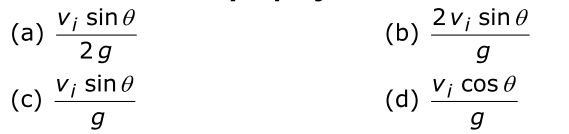
The time taken by a projectile to
reach maximum height is
20.
A ballistic trajectory is the path
followed by
(a)
an un-powered and unguided missile
(b)
a powered and guided missile
(c)
an un-powered but guided missile
(d)
a powered and guided missile
21.
A snooker ball moving with
velocity v collides head-on with another snooker ball of same mass at rest. If
the collision is elastic, the velocity of the second snooker ball is
(a)
zero (b)
uncertain
(c)
v (d)
2 v
22.
The time of flight of a projectile
is
23.
The velocity of a projectile at
the maximum height is
(a)
vi sinθ (b)
vi cosθ
(c)
maximum (d) zero
24.
With increasing angle of
projection, the vertical height gained by a projectile
(a)
decreases gradually
(b)
increases gradually
(c)
first increases and then
decreases (d) remains the same.
25.
The horizontal component of the
velocity of a projectile moving with initial velocity of 500 ms-1 at
an angle of 600 to the x-axis is
(a)
500 ms-1 (b)
1000 ms-1
(c)
250 ms-1 (d) zero
26.
A car is decelerating uniformly,
its velocity changing from 30 ms1
to 15 ms-1 in 75 m. How much further will it travel before coming to
rest?
(a)
25 m (b)
50 m
(c)
75 m (d)
100 m
27.
A body starts from rest at t = 0
and moves with constant acceleration. Which graph below best represents how the
displacement s of the body varies with time?
28.
Laws of motion are valid in those systems
which
(a)
are non-inertial (b)
are inertial
(c)
are at rest (d)
are in space
31.
Neutron (mass = 1 u) undergoes
elastic collision with stationary nitrogen nucleus (mass = 14 u). The velocity
of neutron after the collision is
32.
Area under the velocity – time
graph represents
33.
A body thrown up with a velocity
of 9.8 m/s reaches a maximum height of
34.
A force of 4 N acting on a body of mass 2 kg for 2 s
produces a rate of change of momentum of
35.
Dimensions of impulse are
36.
Collisions of gas molecules with
the walls of the container are the example of
37.
Gas molecules inside a container
constitute
38.
A ball bouncing off a wall
39.
Speed of a projectile is minimum
at the
40.
What happens when a system of two
bodies undergoes an elastic collision?